Mose
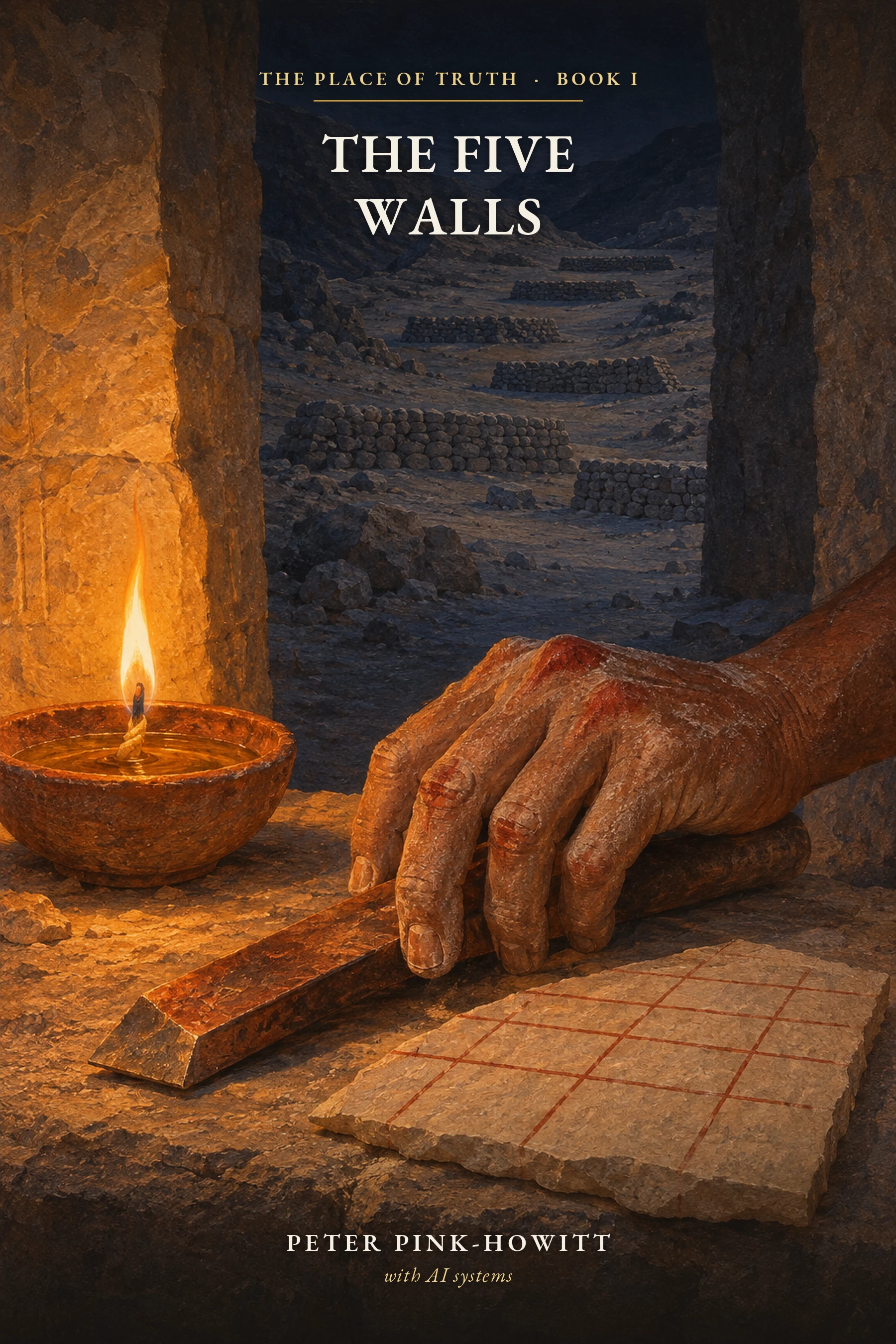
Draughtsman of the Right SideLays out the figures on the tomb walls in red and corrects them in black. He reads every room by its light and its proportions, and knows that a drawn flake of stone cannot be wiped clean.
Years 29 to 32 of Ramesses III and Year 1 of Ramesses IV (c. 1159–1155 BCE) · 324 pp planned · 18.5 mm spine · 15+ floor · 18+ recommended
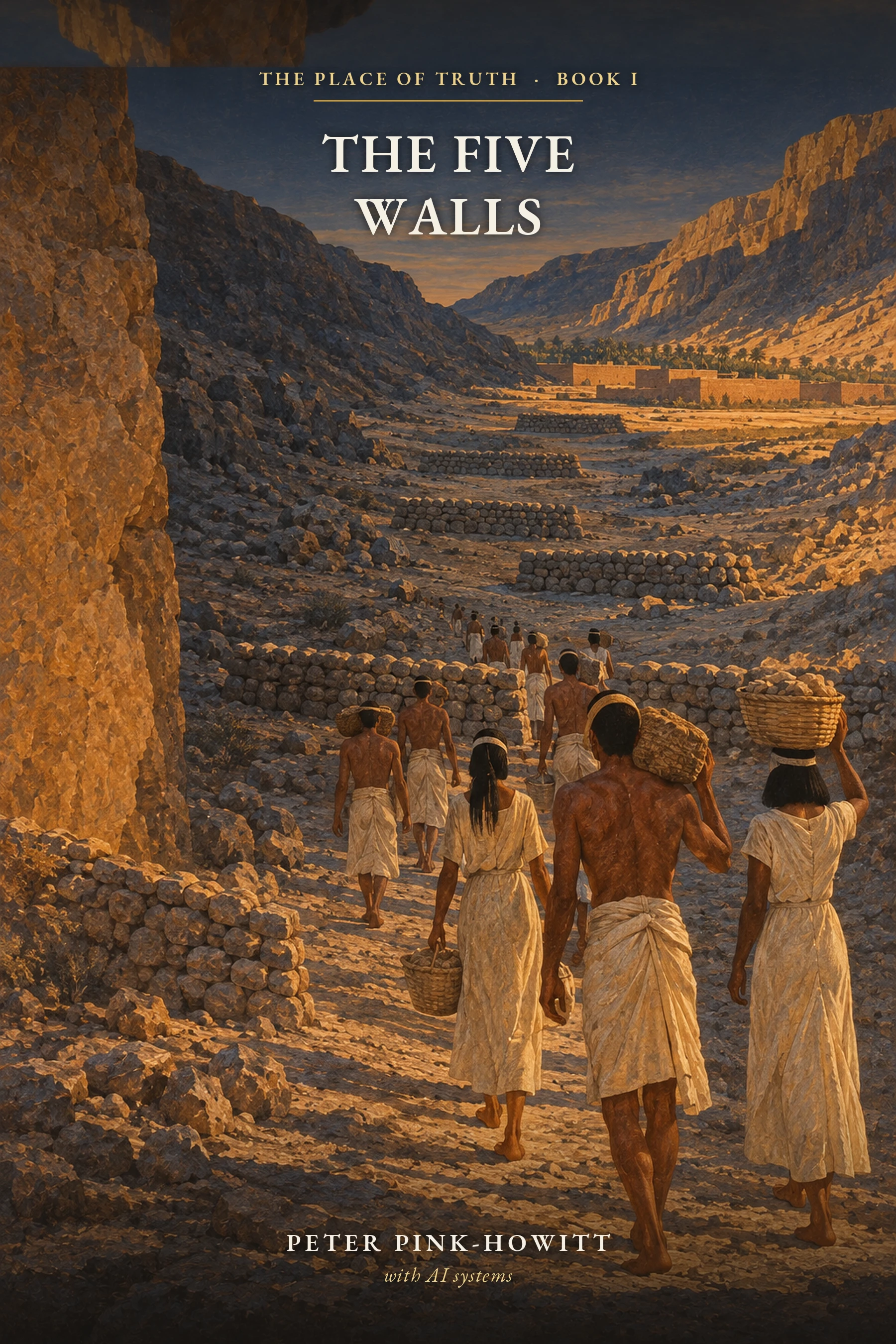
Year 29 of Ramesses III. The grain barges are late, and Set Maat, the walled village of the men who build Pharaoh’s tomb, is running out of bread. Down on the plain the temple storehouses stand full, sealed for the king’s jubilee. On the eighteenth day without rations the crew do something no one yet has a word for: they walk out past the five guard-walls, saying ‘We are hungry’, and sit down behind the temples. Four people live through what follows. Mose lays out the figures on the tomb walls in red and black. Pashedu carries water up from the fields to the village gate and cannot read the tallies kept about him. Tarekhanu weaves, and keeps her household going on grain owed and promised. Montumes, chief of the desert police, holds the walls between the village and the plain. And the scribe Amennakht, seen only from outside, writes it all down, or most of it.
Lays out the figures on the tomb walls in red and corrects them in black. He reads every room by its light and its proportions, and knows that a drawn flake of stone cannot be wiped clean.
Brings water up the wadi by donkey and yoke and pours it at the stand outside the village’s northern gate. He is not allowed further in. He cannot read, and keeps his count in notches on a stick.
Spins and weaves flax, measures what is left in the grain bin, and keeps careful track of who owes her household what.
Holds the five guard-walls between the village and the plain, with the Vizier’s orders on one side and hungry men he knows by name on the other.
In progress. Book I of The Place of Truth, 324 pages (18.5 mm spine). Age guidance: 15 and over, 18 and over recommended. Chapter 1 opening sample below (3,649 words, 4.08% of the 89,446-word manuscript). Drawn from the Turin Strike Papyrus, the village ostraca of Deir el-Medina and the Judicial Papyrus of Turin.
The wick went out with the brush still wet in his hand.
Mose kept the brush where it was. A line half laid is a line that will go on drying whether there is light or not, and if he lifted the hair off the plaster in the dark he would lift it crooked, and a crooked lift leaves a tail, and a tail on the god’s jaw would have to be scraped back to the white and laid again, and there was no white left in the pot. So he held the brush against the wall in the black, and felt the plaster drink at the tip, and waited.
There was no light anywhere. He knew the corridor by its smell now, and by the cold of it on the right side of his face, where the old breach was. Damp marl, sesame fat, the salt they rolled the wicks in, the sour of men who had been eight days on the mountain and four days on one meal a day. Somewhere behind him, up the slope of the passage, a cutter was breathing through his mouth.
“Boy.”
“I’m here.”
“Then be here with fire.”
Khaemope fumbled. Mose heard the flint, the dry scrape, the pot knocked and righted. A spark, another. The boy had been told a hundred times to carry the coal-pot lidded and he had carried it open, and the coal had gone grey, and they would have to send up the passage for fire from the cutters’ lamp. Mose said none of that. He kept the brush on the jaw.
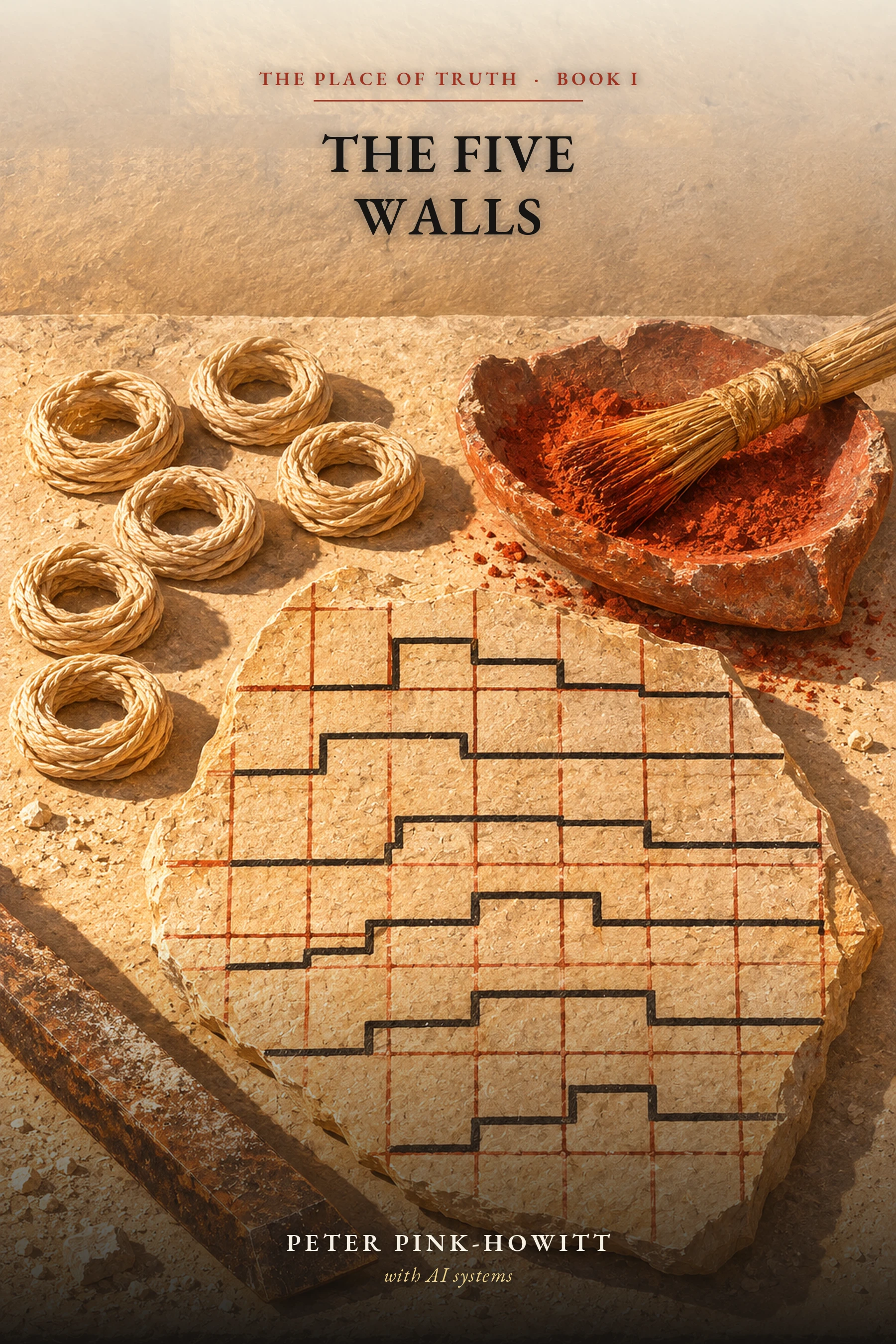
The light came back yellow and small, a ring of salted linen burning in a saucer of fat, and the wall came back with it out of nothing: the red grid Khaemope had laid that morning, eighteen squares from the soles of the god’s feet to his hairline, and over it the black that Mose had been laying since noon, and the god himself standing in his boat with his ram’s head bent toward the next cavern. The brush had held. Mose lifted it straight off the plaster, away from the wall and then down, the way his uncle had taught him, and looked at the stroke.
“Good,” he said. “Where you put the chin on the grid, look. A square low. If I had followed your red he would have a chin on his chest.”
“You told me to count from the feet.”
“I told you to count from the line under the feet. You counted from the toes. The toes are not the ground.”
The boy looked at the wall with his mouth a little open. He was twelve and had good eyes and no patience, and Mose had decided last Akhet that he would make a draughtsman of him or break a reed over his head trying.
Light in the tomb was a sum. Mose had done the sum so many times he did it now without lips moving: so many rings in a decade, so many rings to each lamp, so many lamps for the cutters and so few for the painters, and each ring burnt so long before it had to be pinched and the next one set, and in that time a man could lay so many strokes, and a man who laid too many in one burning would start to lay them too close to the flame and the soot would come down onto the wet white and grey it. White that has greyed is white that has to be cut off the wall and laid again. Five hundred and sixteen rings had come up the mountain at the start of the decade. Mose knew that because he had counted them off the scribe’s table himself, and because there had been, at the start of the decade, a great deal of talk about whether five hundred and sixteen was enough, and none at all about the grain.
The grain was not talked about on the mountain. It was the one thing that could not be helped up here.
Further up the passage, at the jog, the cutters had stopped.
Mose took the lamp from Khaemope and went up. The floor rose, and the walls closed, and the corridor turned. That was the old trouble. The cutters of the old king, Pharaoh’s father, had driven this passage straight into the mountain and broken through into another king’s burial, the chamber of Amenmesse, whom nobody named. They had walled the hole and turned the corridor right and gone on. The patch was still there, mud-brick and plaster, rough, at the height of a man’s shoulder. Twenty years of draughtsmen had painted the wall either side and left the patch alone.
Penanuqet was sitting with his back to the opposite wall and his chisel across his knees. Hay, from the Left Side, stood by him, holding a lamp that had burnt down to a stub of black linen in a skin of fat.
“It’s the jog again,” said Hay.
“It’s the jog with one lamp,” said Penanuqet. “Khonsu wants the edge taken back a hand’s breadth here before you paint the next register. I’m not taking an edge back next to that patch on one lamp with no supper in me. You know what’s on the other side.”
“A dead man,” said Mose.
“A dead man somebody wanted nobody to name. And his things. And whatever he’s owed.” Penanuqet looked up. He had a long face, grey with stone-dust to the eyebrows, and he was a man who could make an argument out of a pair of sandals. “I’ve got a wife at home who hasn’t had a full bin since the flood came down. I’ve got two girls. I’m not going to break a hole into an angry king to save Khonsu a day.”
“Nobody asked you to break a hole.”
“A hand’s breadth, he said. You can’t see a hand’s breadth on that.” He pointed with the chisel at Hay’s lamp. “You can’t see the stone go soft. That patch is soft. You hit it and it goes, and then it’s my name on the sherd.”
Mose held his own lamp to the patch. The plaster was old and dirty and gone to the brown of bad bread. There was a crack in it running from the top left corner a forearm’s length down. There had always been a crack. He could not have said whether it was longer.
“Leave it till we come up again,” he said. “I’ll paint round it.”
“You can’t paint round it,” said Hay. “The register runs straight across.”
“Then the register will not run straight across.”
They both looked at him. He heard it himself. In twenty years he had never let a register break.
“I’m tired,” he said. “The god can walk round a patch.”
Penanuqet laughed, and it went down the corridor and came back off the end wall. “There’s a draughtsman who wants his supper.”
They came off the mountain in the late afternoon of the next day, with the light of the whole western sky against them.
That was the worst of the descent, every decade. Eight days in the tomb opened a man’s eyes to take in the width of a wick and nothing else, and in the late afternoon the sun came low across the western ridge and lay along the white path and the white cliffs across the valley, so that wherever he looked the rock threw it back at him. Mose walked with his eyes on the path and the heels of the man in front. The path was white. The heels were brown and split. Everything had a burning edge to it, a red rim and then a white one.
He had got orpiment under his nails again. The yellow sat in the quick of the right forefinger, glittering when he held it up, and over it lay a grit of blue frit from the ceiling band, coarse, as he had told the boy to leave it, so that the hand was striped like a wall still drying. He picked at it with his thumbnail while he walked, and the yellow went further in.
The gatehouse came up out of the glare at the north end of the village wall: the low roof, the scale-table set out in front of it under its awning, the baskets, the scribe on his stool, the doorkeeper standing at the gate with his staff, and at the side, sunk into the ground by the wall, the great jars of the cistern where the water-carriers poured the day’s water. Beyond the gate was the street. Mose could hear it from the path. Women calling. A loom-beam knocking. A child crying somewhere in a back room, and the child’s mother telling it that crying would not bring the barges.
On the table the wick-rings sat in their baskets for the next ascent, twisted linen the length of his palm, each crusted at the tip with the salt they rolled them in against the smoke. The crew went past the table in file, each man laying his copper on the beam.
“Light,” said Khonsu at the beam, and lifted a chisel off the pan. “Two qedet light.”
“It’s been through flint,” said Penanuqet. “Go and cut flint, and see what comes back to you.”
“Flint, or the coppersmith behind your house?”
There was laughing. Penanuqet’s face went darker under the dust.
“Enter it worn,” said Amennakht, without looking up.
Khonsu looked at the scribe. Amennakht was writing. He wrote on a limestone flake on his knee, the reed going from the pot to the stone and back, and his face was the face he always had at the table, as if the copper and the men bringing it were weather.
“Two qedet in one decade,” said Khonsu.
“Two qedet in one decade on flint nodules in the jog, next to the patch, where the Vizier’s man has never been and will never go,” said Amennakht. “If I write shaved, the Vizier’s man reads shaved, and he does not read flint. Enter it worn.”
Mose’s wife was at the gate already with her basket of sherds on her hip, telling Penanuqet’s wife across three people’s heads about two oipe of flour. Mose kept his back to her.
The water-man came round the corner of the gatehouse then, leading his jenny with the last jars, and the jenny went short on her off fore, and the shouting at the beam made her throw her head, and the jar on her near side swung out and struck the basket, and the rings went into the dust.
Mose was on his knees before anyone told him. Lint came away on his fingers. Grit had stuck to the salt. Each ring had to be blown on and turned and blown again, because a fouled tip spits, and a spit of burning grit on wet huntite leaves a grey bloom no brush lifts, and the Great God would pass through his cavern in peace with a smut on his knee for as long as the mountain stood. He blew and turned and laid them on his thigh in a row, and counted, and there were twenty-one. His hand closed on the last one and went to the fold of his kilt.
Pay’s widow wanted a coffin face by the end of the month. Faces wanted lamp after dark, and a face done for a widow was paid in emmer from her husband’s store, and her husband’s store was the only full one left on the street.
“Leave the salt on them,” he said to Khonsu. “Wipe them and they’ll burn black.”
“How many?” said the scribe.
Amennakht had not stood. The reed was wet in his fingers. He was looking at the dust by Mose’s knee, then at the knee, then at the row.
“Twenty,” Mose said.
The scribe dipped his reed. Behind him the doorkeeper had his shoulder under the gate bar and the water-man was shouting about twelve days of jars, and Mose put the rings back into the basket one at a time, salt end up, with the twenty-first warm against his hip.
She walked beside him into the street and he let her. That was all he could have said afterwards about it: that he let her. They went in under the gate and past the first houses, past Hay’s mother grinding in the dark of her front room with the door open for the last of the light, and Tarekhanu put two fingers into the fold of his kilt as easily as into her own basket and drew the ring out, and he felt it go, a small dry scrape of salt across the skin of his hip, and he did not turn his head.
“Was that Henut shouting or you?” he had said, a moment before, at the gate.
“Was that you counting twenty or the scribe?” she had said.
The house smelled of flax and cold hearth. The boy was asleep on the mat in the front room with his mouth open and one arm flung over his face, and the household god sat in his niche with a bowl in front of him that had held water once. The loom stood along the back wall of the second room with the shed still open. Mose went to the storage bin first because he always went to the bin first, every decade, as if a full bin might have grown in it while he was gone, and lifted the lid, and put his hand in to the wrist, and felt the floor of it.
There was a little. A handful of emmer, swept into the corner. A dead beetle.
“Eight loaves,” said Tarekhanu behind him. “Promised to my brother’s girl. Don’t look at me like a dog under the table.”
“I haven’t said anything.”
“You’ve opened the bin. That’s saying it.” She put her basket down by the loom and began to take out the sherds and lay them in rows on the floor, the way she did, as if they were warp-threads. “Henut says when the barges come. Pay’s widow says the coffin face first and then we’ll talk. Hay’s mother owes me a hin of oil she has, I can smell it through the wall. And the water-man says eighteen jars.”
“What did you give him?”
“A sherd.”
“Which sherd?”
She looked up. Her face had the lamp-coloured skin of a woman who sat all day at a loom in a room with a door open to the street and no window. She had a mole by her mouth that he had once painted on a wall in a private chapel as a joke, on a servant girl carrying a duck, and the man who paid for the chapel had never known.
“One you wrote in the winter,” she said. “Two oipe. It will do.”
“That was Henut’s.”
“Henut’s two oipe that Henut will never pay. So now it’s the water-man’s two oipe that Henut will never pay. He can’t read it, and he turned it over twice to be sure.”
Mose sat down on the mat by the boy’s feet. His eyes still burnt from the descent. He pressed the heels of his hands into them and saw red, and then the god’s jaw, and then the patch with its crack.
“Pay’s widow,” he said.
“Pay’s widow,” said his wife, “will put down security when she sees a face. Not before. She’s Pay’s widow. She knows what a draughtsman’s word is worth.” The ring was not on the floor with the sherds. He could not see where she had put it. “When she puts it down, you’ll have your lamp back.”
At the end of the street, after dark, the men came out.
Not all of them. Penanuqet, with a lamp he should not have had. Khonsu, without one. Two of the Left Side. Hay, for once without his mother calling him in. They stood by the wall of the chapel at the north end, where the street widened, and talked the way men talk who have eaten nothing all day and know that tomorrow is a rest-day and the day after is a day they are meant to go back up the mountain.
“Eighteen days,” said Khonsu. “Eighteen days into the month and the grain not come. Not the half of it, not a quarter. Nothing. The bins are mud.”
“The Ramesseum’s full,” said one of the Left Side. “My wife’s cousin carries for them. Full to the seal. They’re holding it for the jubilee.”
“The jubilee is next year.”
“They’re holding it.”
“We could go and sit at the back of Henket-ankh,” said Penanuqet. “Where they can see us. Past the walls. If we sit behind the temple the temple has to send someone, and if the temple sends someone the someone has to send to the Vizier, and if the Vizier hears that the crew of the Tomb is sitting outside the walls saying we are hungry, then the Vizier has to do something, because if he does nothing then Pharaoh hears it.”
“Pharaoh hears it,” said Hay. “And then what?”
“And then we eat.”
“Or then the Medjay.”
“The Medjay are hungry too. Montumes’s men eat out of the same bins.”
Mose stood with his back to the chapel wall. He could feel the cold of the mud-brick through his tunic. He said, “The tomb is not finished.”
They looked at him. In the dark they were heads and the edges of shoulders.
“The burial chamber has no ceiling yet. The fourth register in the corridor is red. Only red. If we go out past the walls, it stays red. And if it stays red when Pharaoh needs it,” and he heard his own voice go up, and brought it down, “then whose crookedness is that? Pharaoh’s or ours?”
“Pharaoh’s,” said Penanuqet. “Who stopped the grain?”
“A clerk stopped the grain. Some clerk at the Ramesseum with his thumb on the beam. Not Pharaoh. If we cut his tomb right, if the line is right, then the grain has to come. It always comes.”
“It hasn’t come,” said Khonsu.
“It’s late.”
“Eighteen days.”
“It always comes,” Mose said again, and his belly turned over on the word, because it was empty and because there was a ring of linen somewhere in his wife’s storeroom that he had taken off Pharaoh’s table that same afternoon. Nobody on the street knew that but his wife. The scribe had looked at his knee.
Penanuqet said, “You want to go back up and paint the god a nice chin while your boy eats beetles. Go on. I’m going to Henket-ankh.”
In the morning they went.
Mose had not slept much. The boy had woken in the night and cried with hunger in a thin flat way that was worse than shouting, and Tarekhanu had got up and given him something from somewhere, and Mose had lain on his side with his face to the wall and heard him chewing. Hay’s mother had coughed through the party wall until dawn. At first light there were sandals in the street, more than there should have been on a rest-day, all going north.
He got up and put on his kilt and tied it. He did not take his reed-case. He did not know why he looked for it, and then put it down.
Tarekhanu was at the loom with the shed closed and the weft-rod in her hand. She did not stop weaving.
“You said it always comes,” she said.
“I know what I said.”
“Then why are your sandals on?”
He did not have an answer. He went out.
The crew were at the gate, forty or fifty of them, Right Side and Left Side together, with the two foremen at the front and the deputies behind. There were women standing in the doorways watching. The doorkeeper was there with his staff across his chest and no idea what to do with it. The scribe’s stool was out by the table, but the scribe was not on it. The gate was open, because it was a rest-day and the water-carriers had to come in.
Mose went to the back of the crowd, where the Right Side draughtsmen stood. Nobody said anything to him. Penanuqet saw him and looked away and looked back and lifted his chin a finger’s breadth, as if Mose had paid him back a small debt.
The sun had not yet come over the eastern hills. The light was grey and kind and Mose could see the first wall clearly, the lowest of the five, a long dry-stone wall across the mouth of the wadi where it opened on the plain, a few hundred cubits off, with a Medjay sitting on it with his legs hanging down, and beyond it the path bending north-east toward the temples. He could see every stone in it.
Khonsu turned round. “We’re going to sit behind Henket-ankh,” he said, loud, to all of them. “We’re going to sit until they hear us. If anyone wants to go back to bed, go back to bed. Nobody’s writing your name.”
Somebody laughed and said, “Who’d write it?” and looked toward the empty stool.
They went out of the gate. Mose went with them. The gravel was cold under his sandals and the first wall came up, and the Medjay on it got down off it and stood back and let them through, and Mose walked past the end of the wall with his hands empty at his sides, and felt the yellow under his nail with his thumb.